I. Background
As of August 2026, most foreign game companies required to designate a domestic representative under the Game Industry Promotion Act (the “GIPA”) have completed their designations, and one year has passed since the special provisions on liability for damages arising from violations of probability-based item disclosure obligations (GIPA Article 33-2) took effect. However, compliance has not kept pace. A planned inspection conducted this year by the Game Rating and Administration Committee (the “GRAC”) of games serviced by companies that have designated domestic representatives identified numerous violations, including failures to disclose probability information. At the Probabilistic Item User Damage Relief Center, remediation and relief procedures are underway as of June of this year with respect to three cases suspected of involving false probabilities. In July of this year, the GRAC initiated proceedings to restrict distribution of a foreign game product on the ground of a disclosure violation.
Where a violation is established, an operator faces administrative sanctions and civil liability for damages simultaneously, and may also be subject to sanctions under statutes other than the GIPA. On the administrative side, the GRAC may issue a correction request, and the Minister of Culture, Sports and Tourism (the “MCST”) may issue a corrective recommendation or a corrective order; failure to comply with a corrective order may result in imprisonment for up to two years or a fine of up to KRW 20 million.
In addition, under the special provisions that took effect in August 2025, the burden of proving the absence of intent or negligence rests with the game business operator, and where intent is established, the operator may be liable for punitive damages in an amount not exceeding three times the loss. Separately, a discrepancy between disclosed and actual probabilities may give rise to sanctions by the Korea Fair Trade Commission (the “KFTC”) under the Act on the Consumer Protection in Electronic Commerce (the “E-Commerce Act”).
Designating a domestic representative marks the beginning of statutory compliance, not its completion. This TLI identifies the compliance checkpoints foreign game companies should address at this juncture, together with recent legislative developments concerning the designation of domestic representatives and the differing designation thresholds and post-designation steps prescribed by each statute that requires such designation.
II. Matters to Verify
1.Whether the Disclosure Obligations Apply
Game products provided through an information and communications network that offer probability-based items are subject to the disclosure obligations. Excluded, however, are game products supplied to youth game providing businesses and general game providing businesses, game products exempt from rating classification under GIPA Article 21(1), and cases in which every entity that produces, distributes, or provides the game product is a small or medium enterprise in the video, broadcasting and communications, or information services sector with average annual revenue of KRW 100 million or less over the preceding three years (GIPA Enforcement Decree Article 19-2).
As noted above, the disclosure obligations for probability-based items apply independently of the domestic representative designation requirement. A company that falls below the designation thresholds of KRW 1 trillion in revenue or an average of 1,000 daily installations remains subject to the disclosure obligations.
GIPA Article 33(2) requires disclosure of the types of probability-based items and related particulars on the game product, its website, and each advertisement or promotional material. Within the game product, the information must be disclosed directly on the purchase, inquiry, or use screen1 for the probability-based item; on the website, it must be presented in a form searchable by character string or numeric string.
Probabilities are, as a rule, to be expressed as percentages, and may be rounded at a specified decimal place (a decimal place located at least four places to the right of the first non-zero digit). Where a fraction, function, or text-based method would be more readily comprehensible to users, that method may be used instead.
3.Disclosure Content by Item Type
Item 1 of Attached Table 3-2 to the GIPA Enforcement Decree prescribes the required disclosure content according to the characteristics and delivery method of the probability-based item, and requires that where a single item falls under two or more categories, all applicable particulars be disclosed. Where an item delivers another game item, alters the type, grade, or performance of another game item, or combines multiple game items, the probability information for every possible outcome must be disclosed. Where the total quantity or the period of availability is limited, where the probability changes according to the progress of play, or where an item is guaranteed upon satisfaction of specified conditions, the corresponding particulars must additionally be disclosed.
III. Obligations Relating to the Domestic Representative
1.Obligations of the Domestic Representative
The matters represented by a domestic representative are (i) performance of the reporting obligation under GIPA Article 31(2), and (ii) performance of the disclosure obligations under GIPA Article 33. Where these obligations are violated, the game-related business operator is deemed to have committed the act.
The domestic representative must also maintain effective means of contact with the game-related business operator. The GRAC has stated that a domestic representative should not merely forward official correspondence but should accurately explain to the head office the nature of the violation and the manner of remediation.
2.Obligations of the Game Business Operator
Where a disclosure violation is established, a party in receipt of a corrective recommendation or corrective order from the MCST must complete the required measures and report the results within seven days (GIPA Article 38(10)). The GRAC recently stated that, through the domestic representative regime, it had processed 106 correction requests directed at foreign operators through May 2026. It has further explained that where an operator continues to provide a service without responding to a correction request, the game product is removed from the application marketplace, and that following a procedural revision eliminating the corrective recommendation stage from the former four-step sequence of correction request → corrective recommendation → corrective order → removal, removal from the marketplace is now possible within two months of detection.
Operators should therefore assess in advance whether they have internal systems in place that allow the entire process — from the domestic representative's receipt of a corrective request, through the head office's review and remedial action, to the reporting of results — to be completed within these timeframes.
In addition, the name of the domestic representative (for a corporation, its name and the name of its representative), address (for a corporation, the location of its place of business), telephone number, and email address must be included in the terms and conditions. Particular care should be taken to ensure that no required particulars are omitted from the terms and conditions when the representative changes.
IV. Recent Legislative Developments Concerning the Domestic Representative
A comprehensive bill to amend the GIPA introduced by Rep. Cho Seung-rae and ten other members (Bill No. 2213231) 2 would substantially revise the domestic representative regime. Efforts to prevent harm to users would be added to the matters represented by a domestic representative; where the operator has established a domestic corporation or exercises a controlling influence over one, the representative would have to be designated from among such corporations; and operators would be placed under a duty to supervise the domestic representative, including by providing training and monitoring its performance.
If the bill is enacted, operators that have already designated a domestic representative may also be required to change that representative, and further steps may be called for, such as revising delegation agreements and establishing new supervisory procedures. Legislative developments should therefore be monitored on an ongoing basis.
V. Designation Requirements Under Different Statutes
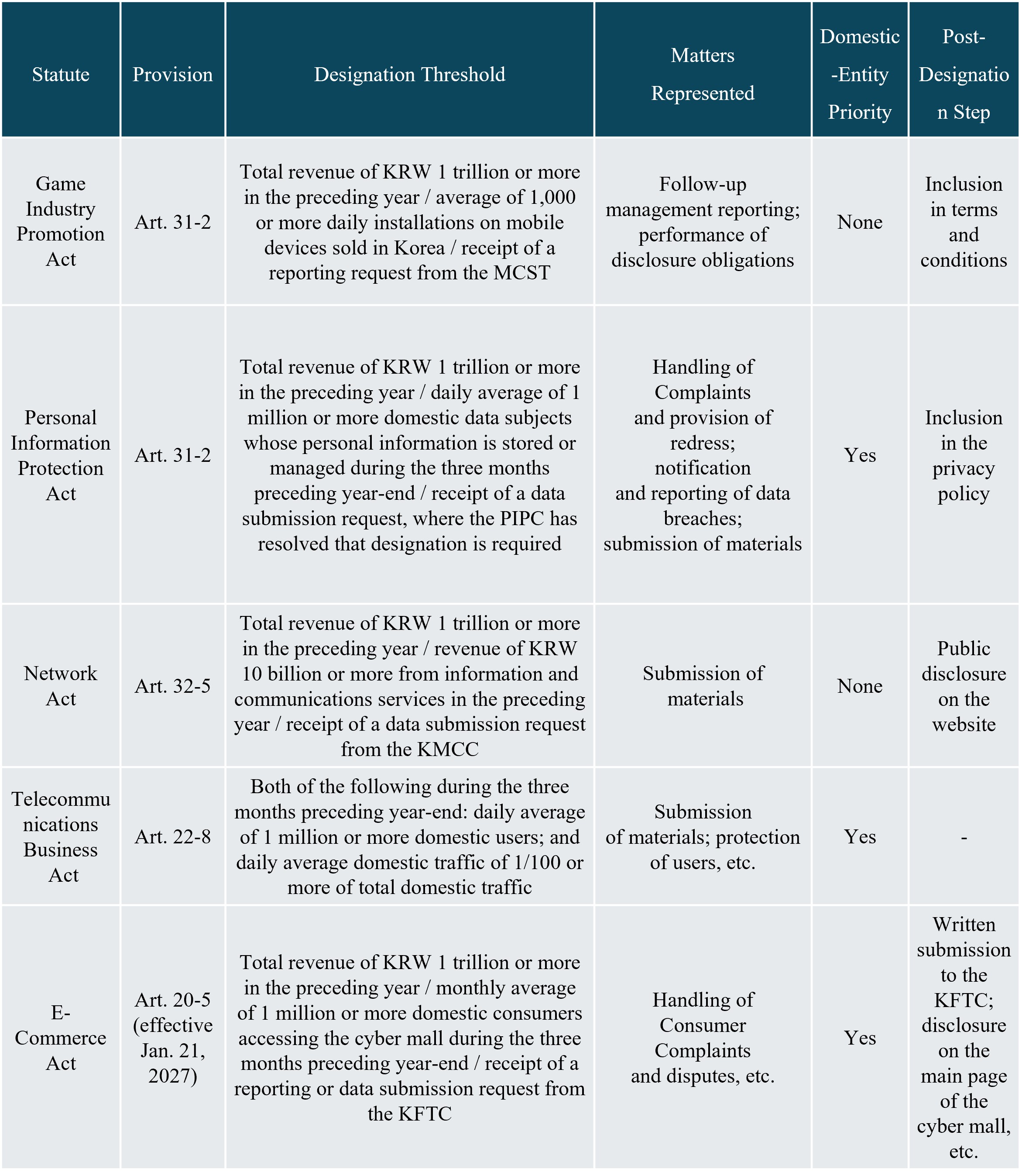
Beyond the GIPA, a foreign game company may, depending on the nature of its services, be concurrently subject to domestic representative designation requirements under the Personal Information Protection Act, the Act on Promotion of Information and Communications Network Utilization and Information Protection (the “Network Act”), the Telecommunications Business Act, and the E-Commerce Act. Each statute prescribes different designation thresholds, different categories of persons eligible to serve as representative, and different post-designation steps. Foreign game companies should therefore first determine which statutes apply to them and the scope of their application, then track, for each statute, the status of their domestic representative designation and the obligations they must perform. Because the thresholds are tied to revenue and user numbers and thus vary from year to year, an annual review procedure is advisable.
|